
William H. Elliot and the Remington Model 95 Double Derringer

The Inventor and the Story Behind One of America’s Most Recognizable Pocket Pistols
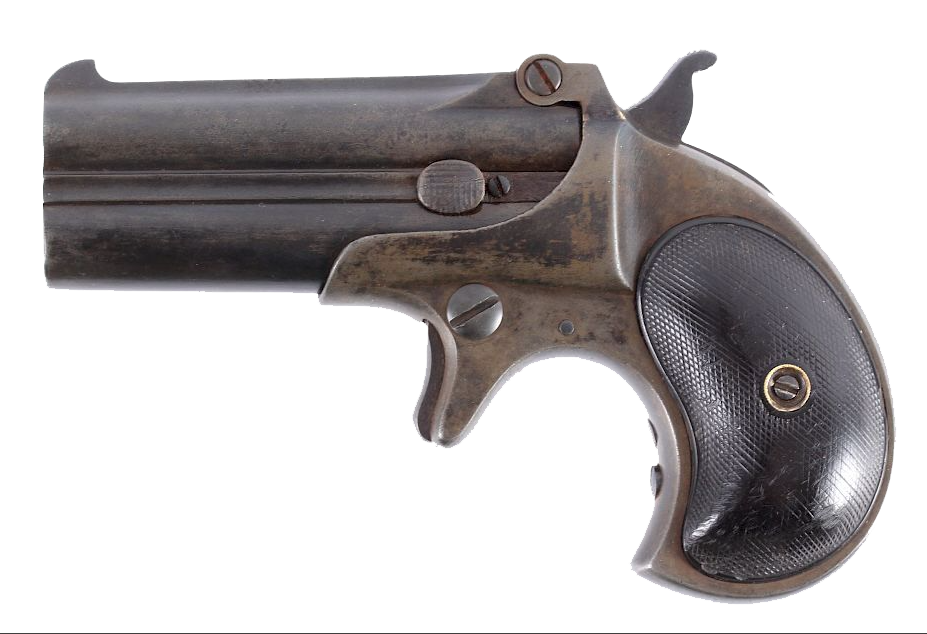
Few nineteenth-century American firearms have a silhouette as immediately recognizable as the Remington Double Derringer. With its compact bird’s-head grip, short over-and-under barrels, spur trigger, and distinctive barrel assembly that tips upward for loading, the little two-shot pistol became an enduring symbol of the concealed arms carried during the American frontier era.

The pistol is commonly called the Remington Model 95 Double Derringer by modern collectors. During its long production life, however, terminology was not always as standardized as the modern name suggests. Period Remington literature commonly described such arms more simply as double derringers or double-barrel pocket pistols.
Behind the design was an inventive nineteenth-century dentist and mechanical experimenter named Dr. William Harvey Elliot.
Elliot's contribution to American firearms history went considerably beyond this single pistol. His patents were used by Remington for numerous firearms, and later in life he also worked with Colt. Nevertheless, the tiny .41-caliber Remington remains the firearm most closely associated with his name.
William Harvey Elliot was born in Leicester, Massachusetts, on April 23, 1816.
His original profession was not gunmaking but dentistry. During the middle decades of the nineteenth century, Elliot practiced dentistry and became sufficiently respected within the profession to contribute articles to dental publications.
For approximately a decade, beginning in the 1840s, he practiced in Montreal, Canada.
Elliot also possessed a strong interest in mechanical design. That interest eventually drew him toward firearms development at a time when American gunmaking was undergoing enormous technological change.
The percussion era was giving way to self-contained metallic cartridges. Inventors were experimenting with breech-loading mechanisms, repeating firearms, cartridge extraction systems, and increasingly compact personal-defense weapons.
Elliot became part of that technological revolution.
By the late 1850s, Elliot had established a relationship with E. Remington & Sons of Ilion, New York.
Remington was already one of America's major arms manufacturers. The company possessed the machinery and manufacturing capacity necessary to turn an inventor's mechanical concepts into commercially produced firearms. Elliot provided something equally valuable: ideas.
During his association with Remington, numerous Elliot-designed firearms appeared, particularly compact cartridge pistols.
Among them were several unusual multi-barrel firearms that demonstrated Elliot's fascination with placing substantial short-range firepower into extremely small packages. That philosophy would ultimately produce his most famous design.
One particularly important surviving document is William H. Elliot's U.S. Patent No. 28,461, issued May 29, 1860.

The patent concerned an improved pocket pistol. Elliot explicitly described his goal as producing a firearm combining compactness with useful power and mechanical strength. This is significant because it reveals the philosophy underlying much of his firearms work.
Elliot wasn't just trying to reduce the size of guns; he aimed to address the engineering challenge of designing a firearm that was easy to carry yet strong and effective enough for personal protection.
Many of Elliot's designs created by Remington adhered to this fundamental principle.
To comprehend the Double Derringer, one must understand the era during which Elliot designed it.
During the 1850s and 1860s, metallic cartridges brought significant changes to firearms.
Previously, percussion firearms needed the shooter to load powder and projectile separately and then attach a percussion cap to the nipple. A metallic cartridge integrated all the necessary ammunition components into a single, compact unit.
The benefits for small defensive pistols were significant.
Cartridges could be easily carried.
The firearm was much simpler to load.
A breech-loading pistol could also be designed to be very compact.
This technological shift allowed Elliot's pocket pistols to thrive.
A single-shot pocket pistol provided maximum simplicity, but it had a clear drawback:
only one shot.
A revolver enabled multiple shots, but the cylinder increased the firearm's width, mechanical complexity, weight, and overall size. Elliot's approach struck a balance.
He arranged two barrels vertically, providing the shooter with two easily accessible cartridges without requiring a revolving cylinder. This design resulted in a pistol that was slim, mechanically straightforward, and highly compact. This fundamental idea developed into the Remington Double Derringer.
The design most directly associated with the famous Remington pistol was protected by U.S. Patent No. 51,440, granted to William H. Elliot on December 12, 1865.
The patent covered important elements of the breech-loading double-barrel pistol.
The finished Remington incorporated two superposed barrels and a hinged barrel assembly.
The shooter would open the barrel latch and tilt the barrel unit upward to load the pistol, revealing the chambers at the breech.
At this point, a cartridge could be placed into each chamber.
Closing the barrels would then reset the pistol to its firing position.
This design produced a firearm that was notably compact while still offering two shots.

Externally, the pistol appears mechanically simple, but the mechanism is ingenious. The two barrels are arranged vertically. There is only one hammer.
Instead of requiring two separate hammers, the pistol uses a mechanism that alternates the hammer's firing pin between the upper and lower cartridges.
After one barrel has been fired, cocking the hammer prepares the pistol to fire the other barrel. Thus, two cartridges can be discharged sequentially using a single hammer and trigger. This arrangement contributes enormously to the pistol's compact dimensions.
The classic Remington Double Derringer was chambered for the .41 rimfire cartridge.
The cartridge belongs to the early metallic-cartridge era.
Unlike modern centerfire ammunition, in which the primer is located in the center of the cartridge base, rimfire ammunition contains its priming compound within the hollow rim of the cartridge case.
The firing mechanism crushes part of that rim, igniting the priming mixture and subsequently the powder charge.
The .41 rimfire cartridge was particularly well suited to small defensive pistols.
It permitted the construction of a compact firearm while providing a projectile substantially larger in diameter than many of the tiny .22- and .32-caliber pocket cartridges of the era.
The .41 rimfire should not be confused with later high-powered .41-caliber cartridges.
Its purpose was fundamentally different.
It was intended primarily for close-range personal defense.
The Double Derringer had short barrels and rudimentary sights. It was not designed as a long-distance target pistol or military sidearm.
Its advantages were instead:
compactness
concealability
simplicity
and the availability of two shots
The combination of the .41 rimfire cartridge and Elliot's extremely compact pistol created a practical nineteenth-century defensive arm.
Production of Elliot's Double Derringer began shortly after the Civil War, generally placed around 1866.
This timing was important. The United States was entering a period of enormous westward movement, expanding rail transportation, rapidly growing cities, mining booms, and increasing commercial travel.
There was a substantial civilian market for compact personal-defense firearms.
Remington's little double-barrel pistol fit that market extremely well.
The derringer primarily was in the hands of gamblers, saloon patrons, frontier women, and professional gunfighters. Such associations are understandable, but they can create an overly narrow picture. The Double Derringer was fundamentally a commercial civilian pocket pistol. Its potential customers included travelers, businessmen, shopkeepers, gamblers, lawmen, and anyone else who wanted a firearm substantially smaller than a full-sized revolver.
It was suitable for concealed carry in situations where a large belt revolver would have been inconvenient or conspicuous. That helps explain its extraordinary commercial longevity.
Modern collectors generally know the firearm as the:
Remington Model 95 Double Derringer
or simply:
Remington Model 95
The designation is useful because it clearly separates the famous over-and-under pistol from the numerous other derringer-type firearms manufactured by Remington and its competitors.
However, collectors should be cautious about assuming that every modern model designation corresponds precisely to the terminology Remington used throughout the nineteenth century. Period catalogs and advertisements often used descriptive names rather than the standardized collector nomenclature familiar today.
Because the Double Derringer remained in production for decades, numerous mechanical and cosmetic changes occurred.
Collectors consequently divide surviving pistols into several major types and numerous sub-variations.
One commonly encountered collector classification separates them broadly into:
First Model
Second Model
Third Model
These categories are based primarily upon mechanical construction and manufacturing changes rather than dramatic changes to the pistol's overall appearance.
This is important because two Remington Double Derringers manufactured decades apart can appear remarkably similar at first glance.
Closer inspection may reveal significant differences.
First Model
The earliest production pistols represent Elliot's design in its initial commercial form.
These early examples are particularly interesting because they are closest chronologically to Elliot's original patent work.
Characteristics used by advanced collectors to identify early production include details involving the barrel hinge, extractor, barrel markings, frame construction, and other small manufacturing features.
Early examples can be especially desirable when they retain strong original finish and clearly legible markings.
Because Remington continually refined the design, seemingly minor mechanical details can substantially affect collector classification.
Second Model
Later production incorporated improvements intended to strengthen or simplify the pistol.
These changes resulted in what collectors generally identify as the Second Model.
The overall concept remained unchanged:
two vertically stacked .41 rimfire barrels,
a single hammer,
a spur trigger,
and a hinged barrel assembly.
Internally and structurally, however, Remington continued refining the pistol.
The evolution demonstrates something important about nineteenth-century firearms manufacture.
Successful guns were rarely frozen in their original configuration.
Manufacturers continually adjusted machinery, components, markings, materials, and mechanical details as production continued.
Third Model
The later and generally most familiar configuration is commonly identified by collectors as the Third Model.
Third Model pistols themselves exist in multiple variations.
These later examples account for a substantial portion of surviving Remington Double Derringers and demonstrate how remarkably long the basic Elliot design remained commercially viable.
Despite manufacturing changes, the essential appearance established during the nineteenth century survived.
A person familiar with an early Double Derringer would have had little difficulty recognizing one manufactured decades later.
Among the important features collectors examine when classifying Double Derringers are the extractor system and barrel hinge arrangement.
These were not merely cosmetic differences.
Repeated opening and closing placed mechanical stress upon the hinge and related components.
Remington modified aspects of the design during production, and those modifications now help collectors estimate the period and variation to which an individual pistol belongs.
Small mechanical details therefore matter considerably more than they might appear to the casual observer.
Barrel inscriptions are another valuable identification tool.
Remington's corporate identity changed during the pistol's long production history, and barrel markings changed accordingly.
Variations may reference:
E. Remington & Sons
and later corporate forms associated with the Remington company.
Patent information can also appear in markings.
Because markings changed at different points, they can provide useful evidence when attempting to classify or approximately date a surviving pistol.
However, markings should be considered together with mechanical features rather than used alone.
Double Derringers were manufactured with different finishes and grip materials.
Nickel-plated examples are particularly familiar today, although other finishes were produced.
Grip materials and styles also varied.
Some surviving examples display elaborate engraving, special finishes, or decorative grips.
Highly embellished examples demonstrate that the Double Derringer occupied more than one segment of the market.
It could be a practical defensive pistol, but it could also be sold as an attractive personal firearm.
Dating individual Remington Double Derringers can be surprisingly complicated.
Serial numbers are useful, but they should not always be treated as a simple uninterrupted chronological sequence covering the entire production period.
Changes in corporate ownership, production practices, model variations, and surviving factory information complicate the subject.
For a serious collector identification, the best approach is to consider several features together:
serial number
barrel markings
hinge construction
extractor configuration
frame details
grip style
finish
and other manufacturing characteristics.
The combination provides much stronger evidence than any single feature.
The Double Derringer survived major changes within the Remington company itself.
E. Remington & Sons encountered serious financial difficulties during the 1880s.
The old company ultimately entered receivership, and its assets were reorganized under new ownership.
The resulting Remington Arms Company continued firearms production.
Remarkably, Elliot's little pistol survived the transition.
That alone says something about the design's commercial success.
Manufacturers generally do not continue producing an obsolete product through corporate restructuring unless there remains a market for it.

The Remington Double Derringer remained in production into the early twentieth century. Depending upon the source and the particular production chronology being used, production is generally described as continuing until approximately 1935.
That means the basic Elliot concept survived for roughly seven decades.
The world had changed dramatically during that period.
When the pistol first appeared, metallic-cartridge firearms were still relatively new.
By the time production ended, automobiles, airplanes, radio, modern repeating pistols, and smokeless-powder ammunition had transformed American life.
Yet the basic two-shot Remington remained recognizable.
Production estimates vary somewhat among references and depend upon how particular models and production periods are counted.
A figure of more than 150,000 pistols is commonly cited for the Double Derringer family.
Regardless of the precise final number, production was substantial.
More importantly, it occurred across an extraordinarily long period.
Surviving examples are consequently encountered in numerous configurations and conditions.
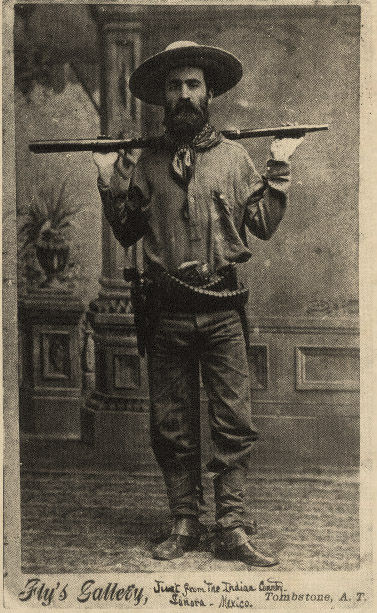
Because production began during the great post-Civil War expansion into the West, Remington Double Derringers were certainly available during the classic frontier period.
This includes the era associated with cattle drives, mining camps, railroad expansion, boomtowns, and famous communities such as Tombstone, Arizona.
For historical interpretation, however, an important distinction should be maintained.
The fact that a particular firearm was available during the Old West does not prove that a specific historical person carried one.
Modern claims assigning particular derringers to famous gamblers, lawmen, or outlaws should therefore be evaluated against documentary or provenance evidence.
What can safely be said is that compact cartridge pistols of this general type were part of the nineteenth-century American personal-defense market.
The Double Derringer's greatest advantage was its size.
A full-sized revolver might be carried openly in a holster.
The little Remington could be carried far more discreetly.
Its rounded grip minimized unnecessary bulk, while its short over-and-under barrels kept the pistol narrow.
The spur trigger eliminated the need for a conventional trigger guard.
Every major feature supported the same objective:
make the firearm as compact as reasonably possible.
That design philosophy can be traced directly back to Elliot's interest in powerful but conveniently carried pocket firearms.


Comments